
A powerful golf swing comes from one thing: the kinetic chain firing in the right order. Hips first, torso second, arms third, hands and golf club last. A golfer who fires those four links in the right order generates effortless speed and produces powerful, repeatable contact and clean ball striking. A golfer who fires them in the wrong order (most commonly arms first) leaks power and ends up muscling the club to compensate, with the clubface twisting through the ball instead of squaring up. Every other one of the powerful golf swing tips you'll read about (grip, posture, alignment, equipment, training aid use, fitness, mental game) only works if the kinetic chain is already firing in sequence. Get the sequence right and the rest of the fundamental tips compound. Get the sequence wrong and no amount of grip work will save your distance, even for a beginner who's just learning to improve your golf swing.
This guide walks through the principles behind a powerful golf swing, then the eight golf swing tips that actually move the needle for any golfer, what equipment matters, and the drills coaches use to build power without sacrificing accuracy. It closes with the questions golfers ask most about generating real, repeatable power.

The principles behind power generation
Power in any athletic motion comes from force applied over time. In golf, the body has roughly 0.25 seconds to transfer force from the ground to the clubhead. That's it. There's no time to muscle anything. The only way the body can produce serious clubhead speed in that window is through proper sequencing and clean swing mechanics, where each segment of the body decelerates just as the next segment accelerates. The hips slow as the torso speeds up. The torso slows as the upper body and arms whip through. The arms slow as the club releases on a consistent swing plane.
Titleist Performance Institute's biomechanics archive documents this sequence across hundreds of tour-level swings, and the consistent finding is that elite players show a clear deceleration pattern from the ground up. Amateurs who try to "swing harder" by adding effort actually disrupt the sequence because they accelerate later segments before earlier ones have decelerated. The result: more effort, less speed.
Tip 1: Get your grip right
A weak grip kills power generation because the hands can't release the club through impact. The proper grip I teach my players: two and a half knuckles visible on the lead hand, V's of both hands pointing at the trail shoulder. From this position, the wrists can hinge and release naturally, which is how the clubhead actually accelerates through the ball. Players with smaller hands sometimes need a thinner grip size so that hand pressure stays light enough to allow that release.
The grip-pressure dial is just as important. Tour pros grip the club at roughly 5 out of 10 on a pressure scale, while most amateurs grip at 8 or 9. Light pressure lets the wrists work. Tight pressure freezes them. Spend a session focused on grip pressure alone and you'll usually pick up a few mph just from letting the club whip through.
Tip 2: Use alignment aids during practice
Power without direction is wasted. Alignment sticks on the ground during every practice session train the body to deliver the club in line with where you're actually aimed. The standard setup: one stick along your toe line, one along the target line, six inches outside the ball. If your shoulders are aimed left or right of the target stick, you've found one of the most common power leaks before you've even swung.
The reason alignment matters for power specifically: a body that's aimed left of the target tends to throw the club outside-to-in to get back to the target, which kills the rotational power the swing depends on. Fix alignment, set the stick parallel to the target line, and the correct swing path issues that drain power often clean up on their own. Ball position matters here too. A ball that's drifted too far back in the stance forces a steep, incorrect swing that bleeds speed.
Tip 3: Use clubs that actually fit you
Most amateurs play golf clubs with the wrong shaft flex, the wrong lie angle, or the wrong grip size. Any one of those wastes power that no swing change can recover. A shaft too stiff means the body can't load the club fully on the backswing. A shaft too whippy means the club arrives at impact with the face open, which leaks distance to a fade or slice.
The fix: a basic club fitting session at a fitter who measures launch conditions. Total time, about two hours. Total cost, often the price of a single lesson. The return: usually 5 to 15 yards of distance just from the equipment being matched correctly to your actual swing.
Tip 4: Fire the lower body first
This is the single most important power tip in the entire guide, and one of the best golf swing tips I share with players who want to play better golf. To initiate the downswing properly, fire from the ground up: front foot pushes into the ground, hips rotate toward the target, torso follows, the lead arm and upper body come through, club whips at the ball. The swing thought I use with my own players: feel like your front foot fires before your hands move. If you feel hands first, you've already lost the kinetic chain and you're left to manufacture speed with the arms, which is one of the most common mistakes I see on the lesson tee.
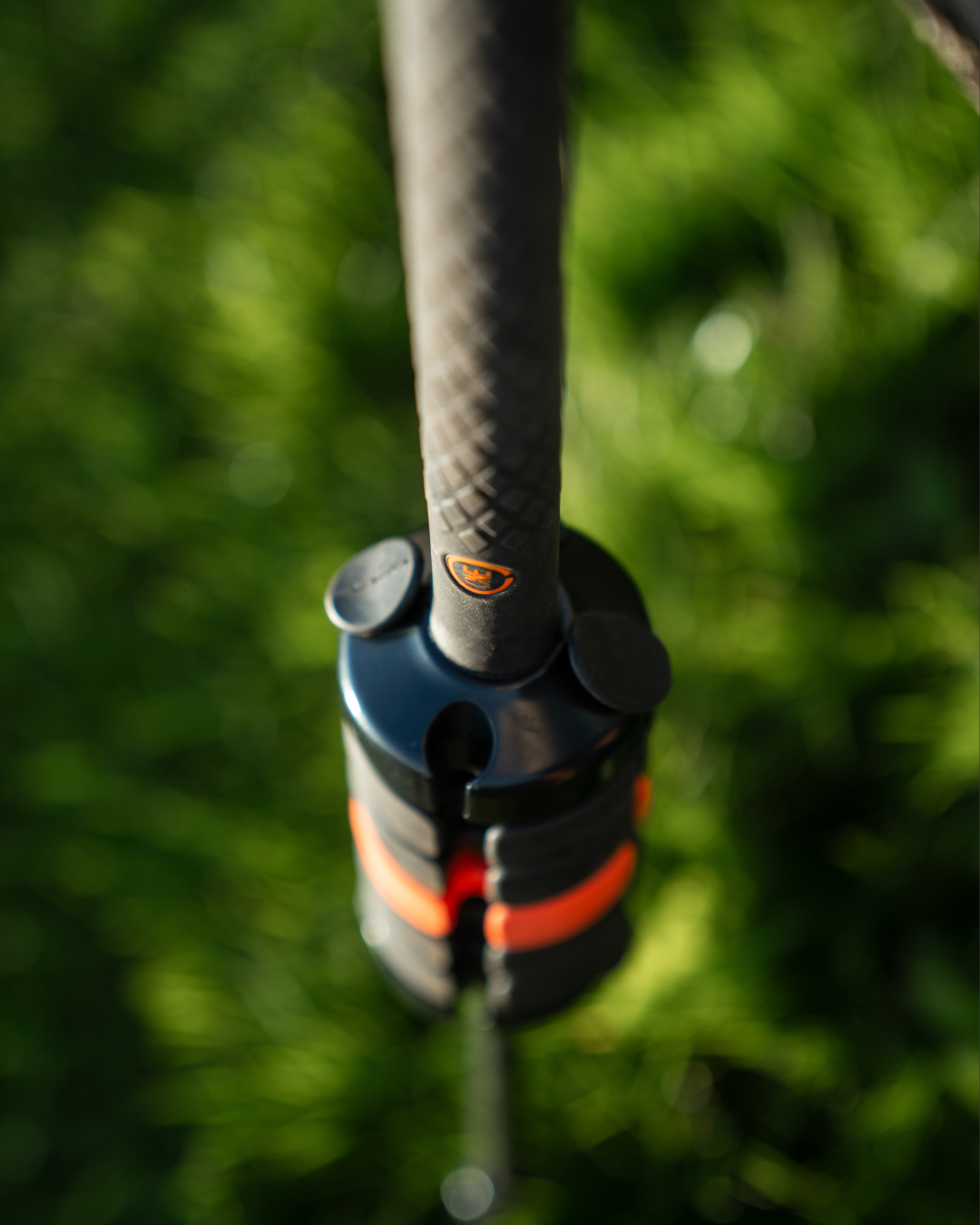
A weighted swing trainer like the ONE Club Trainer is one of the most effective tools for ingraining the right sequence because the added load makes a top-down arms-first swing physically harder. The body learns the correct order because the wrong order doesn't work. Ten minutes a day for three weeks usually shifts the sequence noticeably for most amateurs.
Tip 5: Build rotational strength
Power generation requires the muscles that drive rotation: glutes, obliques, lats. None of those get loaded enough in a typical gym routine of bench press, bicep curls, and treadmill work. The rotational exercises that actually build golf power: medicine ball throws (rotational and overhead), cable rotations from chest height, Russian twists with weight, and weighted rotational lunges.
Three sessions a week, 45 minutes each, with these movements as the core of the workout, will build the rotational power base most amateur golfers are missing. Combined with traditional lower-body strength work (squats, Romanian deadlifts), this is the fastest path to real, sustained power gains that translate to every iron in the bag, not just the driver.
Tip 6: Coil through your trail leg, don't sway off it
A swaying backswing kills power. The trail leg has to act as a wall, with the trail hip turning and loading against it rather than sliding past it. The visual I give my students: imagine your trail foot is stuck in a bucket. The hip can turn, but the foot can't slide. That mental image is enough to fix most amateur swaying issues within a session.
You can drill this at home without a golf ball. Set up against a wall with your trail hip touching it, feet shoulder-width apart. Make slow backswings without letting the hip leave the wall, all the way to the top of the backswing. The trail hip should rotate but not translate, and your back foot should stay planted under that rotating hip. Once the move feels natural, the same constraint shows up automatically in your real swing on the golf course, where you'll start to hit the ball with the chest finally able to face the target through impact rather than hanging back. That kind of grooved, repeatable swing is what holds up under tournament pressure.
Tip 7: Add overspeed training
The nervous system fires at the speeds it's trained to fire. Most amateurs train at their normal swing speed, so the body never learns to swing faster than that. Overspeed training, where you swing a slightly lighter implement at maximum effort, teaches the nervous system to recruit muscle fibers faster than your normal swing does.
SuperSpeed Golf's research on overspeed training documents the science behind the gains. Done correctly (three short sessions a week, 15 to 20 swings per session), overspeed work produces 3 to 7 mph of speed in 8 to 12 weeks for most amateurs. The catch: it has to be paired with full-effort intent. Swinging the light club at half-speed produces zero adaptation.
Tip 8: Don't forget the mental side
Power under pressure looks very different from power on the range. The body tightens up when the brain perceives stakes, which short-circuits the kinetic chain. The fix is built into the pre-shot routine: two slow exhales before stepping into the ball, which resets the nervous system and lets the body return to its trained sequence.
I learned this the hard way myself in regional events early in my coaching career. My range swing was producing 110 mph driver speed easily, with long, straight golf shots. My tournament swing dropped to 102 because I was unconsciously tightening up. Adding the breathing cue brought tournament speed back within 3 mph of range speed within a season. Most of my students who try it see similar results, and it's one of the simplest golf tips for taking your golf game to the next level when the pressure rises.
Powerful golf swing questions
How can I generate more power in my golf swing?
Sequence the downswing from the ground up: lead foot, hips, torso, arms, club. That's the single biggest source of effortless power. Pair that with rotational strength work in the gym and overspeed swings on the range and you have the three pillars that build real, repeatable power.
How long does it take to add power to my swing?
Most amateurs see meaningful gains in 6 to 12 weeks of consistent work. The sequencing fixes show up in the first month, the strength gains in the second, and the speed gains in the third. After 12 weeks of dedicated work, 5 to 10 mph of additional clubhead speed is realistic for most players.
What's the biggest mistake amateurs make when trying to add power?
Swinging harder with the arms instead of sequencing properly. More effort with a bad sequence produces less speed, not more. There's no perfect swing waiting at the end of pure effort. The fix is to slow the swing down, get the order right, and let the speed emerge naturally from the kinetic chain. Effort comes from the legs, not the arms.
Do swing trainers help build a more powerful swing?
Yes, particularly weighted trainers that add load to the club. The added weight forces the body to commit to the correct sequence because the arms alone can't move it efficiently. A tool like the ONE Club Trainer, used in slow motion for 10 minutes a day, compounds the sequencing work most amateurs need.