
The golf swing fires a specific stack of muscle groups in a specific order: the glutes and hamstrings push the ground, the core transmits that force up the chain, the lats and rear delts rotate the torso, and the rotator cuff plus the forearms control the clubface at the moment of impact. Most amateurs train the wrong ones (biceps, chest, the front of the shoulder) and ignore the ones that actually generate clubhead speed. Research published by the National Strength and Conditioning Association on golf-specific training has shown for years that rotational power and hip strength correlate with driver speed far more than upper-body bulk does, which is why even slim tour players outdrive bigger amateur golfers.
This guide walks through the actual anatomy of the golf swing, muscle group by muscle group: which ones fire during the takeaway, which take over in the downswing, which stabilize the clubface, and which you should actually be loading in the gym to add yards. It closes with the five exercises a golfer can do at home in twenty minutes that target every one of them.

The anatomy of the golf swing: which muscles fire when
Most players I work with are shocked when I tell them how many muscles a full golf swing recruits. The number is over 30, but they do not all fire at once. The motion breaks into four phases. Each phase loads a different group, and skipping any of them in training is the fastest way to build a swing with a weak link. At address, the lower-body postural muscles do the holding: the gluteus maximus, the quadriceps, and the erector spinae running up the spine. The backswing loads up the trail-side lats, the oblique muscles on the lead side, and the deep stabilizers between the shoulder blades. The downswing reverses everything in a specific order. The hips initiate first, so the glutes fire, then the obliques, then the lats and the pectoralis major across the chest, and the forearm muscles last. The follow-through decelerates everything using those same muscles in reverse, plus the rotator cuff muscles holding the shoulder joint together. The adductor muscles of the inner thigh handle stability throughout, which is why my older players who skip leg work end up with one-legged finishes.
The reason all this matters: a golfer who skips a muscle group in training ends up with a weak link the rest of the chain has to compensate for. The most common weak link I see, by a mile, is the glutes. That is why so many of my new players swing entirely with the arms and end up with sore lower backs after a round. Fix the glutes, fix the back pain, fix the swing. In that order.
Core muscles: the powerhouse of every swing
Think of the core as the transmission of the swing. Power generated by the lower body has to pass through the trunk to reach the arms and the club, and a weak core leaks that power. In golf, "core" does not just mean the rectus abdominis, the six-pack muscle most people picture. It includes the obliques (both internal and external), the transverse abdominis, the quadratus lumborum, and the multifidus that runs up the spine. Together they let the torso rotate while the hips stay stable. That disassociation between hips and shoulders is what stores the elastic energy that ends up in the ball.
I screen every new player with one move: a side plank held for 45 seconds per side without the hip sagging. If they can't, I know exactly where their swing will break. The obliques and the deeper abdominal muscles are almost certainly the weak link. Titleist Performance Institute's fitness library uses the same assessment as a baseline screen for tour-level golfers, and the players who fail it almost always show power-leakage in their swing data. They try to swing harder with the arms to compensate, and that just makes the contact worse.
Glutes and hamstrings: the hidden powerhouses
The glutes are the largest muscle in the body and, in my opinion, the single biggest driver of club head speed in a properly sequenced swing. They do two things at once. They stabilize the pelvis at address so the hips can rotate against a solid base. Then they fire explosively in the downswing to drive the lead leg into the ground. That ground reaction force, the pressure the body exerts back against the turf, is what creates the whip in the kinetic chain. Tour pros generate ground-reaction forces of roughly 2x bodyweight at the moment of peak push. Most of the amateurs I screen come in under 1.5x, and they always wonder why their tee shots feel "stuck."
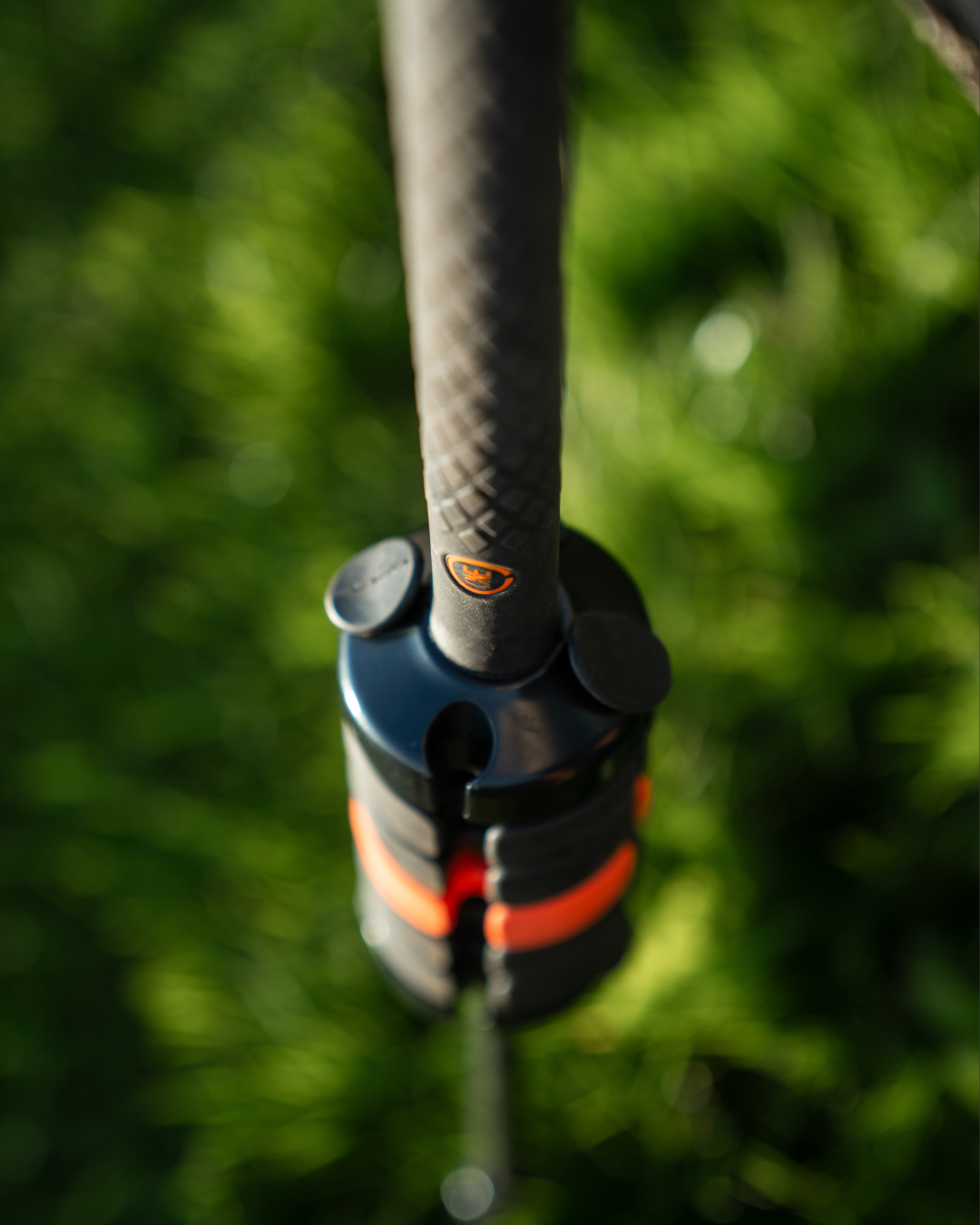
The hamstrings and the rest of the lower body do the supporting work. The hamstrings stabilize the knee through rotation. The quadriceps hold posture. The calves contribute the final push off the ground. A weighted swing trainer like the ONE Club Trainer is one of the tools I keep on the lesson tee for training this sequence, because the extra load forces the lower body to fire harder. You can't fake the move with arms when the club itself is resisting you.
Lats, rear delts, and the rotational engine
The latissimus dorsi (lats) is the biggest muscle in the upper body and the primary mover of the arms across the chest. In golf, the lats do the heavy lifting on the backswing for a right-handed player: the trail-side lat stretches, stores energy, and then unloads in the downswing to bring the club back through. The lead-side lat then takes over to pull the club through impact toward the finish. This is one of the main muscles used in golf swing power.
Pair the lats with the rear deltoids and the rhomboids between the shoulder blades, and you have the rotational engine of the swing. Most amateurs are weak through the entire back side of the upper body because typical gym work, including the bench press and the overhead press, emphasizes the chest muscles and the front of the shoulder. Adding a pull-up or two to a weekly strength training routine corrects that imbalance fast. Otherwise it shows up as a "chicken wing" finish where the lead arm bends prematurely and the club cuts across the ball.
Rotator cuff and forearms: the unsung stabilizers
The rotator cuff is a small group of four muscles (supraspinatus, infraspinatus, teres minor, and subscapularis) that wrap the shoulder joint. They are the joint's main stabilizer. They do not generate power, but they keep the head of the humerus seated in the socket through the violent rotation of the downswing. A weak rotator cuff is the number one reason golfers above 40 develop shoulder pain, and it is also the reason the clubface tends to drift open through impact under fatigue.
The forearm muscles control the wrists, and the wrists control the clubface. Strong, mobile forearms let a golfer maintain a stable face angle through impact without manipulating the club with the hands. Grip strength specifically correlates with driver swing speed in nearly every PGA Tour Performance Institute study published in the last decade. The ONE Club Trainer's weighted feedback design helps build this forearm and grip endurance naturally, since holding the club steady through resistance is essentially the same demand the wrists face in a real swing.

How to actually train these muscles for golf
You do not need a gym to load the right muscle groups for golf. Five exercises, three days a week, will produce measurable speed gains in six to eight weeks. The combination targets every group above without any single exercise eating more than five minutes.
Step one: Goblet squats. Hold a single dumbbell or kettlebell at your chest and squat to parallel for three sets of ten. This loads the glutes, quads, and core all at once and trains the ground-reaction force pattern.
Step two: Single-leg Romanian deadlifts. Standing on one leg, hinge forward at the hip and reach the floor with a dumbbell in the opposite hand, three sets of eight per side. This deadlift variation builds glute and hamstring strength while training the lateral stability your lead leg needs during the downswing. If single-leg work feels unstable, swap in a standard reverse lunge with a dumbbell in each hand.
Step three: Side planks. Hold a side plank for 45 seconds per side, three sets. This trains the obliques in exactly the loaded-rotation pattern they work in during the swing.
Step four: Cable or band rotations (or medicine ball throws). Attach a resistance band to a sturdy post at chest height, set up in your golf posture, and rotate through the swing arc for three sets of twelve per side. If you have access to a medicine ball, the rotational throw is even better because it trains the same pattern explosively. Both build the lats and core through full range.
Step five: Farmer's carries. Pick up the heaviest dumbbells you can hold and walk 30 meters, three sets. This builds grip, forearm, and trap strength, which directly translates to a stable clubface at impact.
Run that sequence three times a week for eight weeks, keep your normal practice routine, and you should see two to four mph of driver speed added. A peer-reviewed study in the Journal of Strength and Conditioning Research showed exactly that range of speed gain across a group of amateur golfers who did rotational and lower-body strength work for eight weeks.
Golf swing muscle group questions
What muscles help most with the golf swing?
The glutes and core do the heaviest lifting, followed by the lats and the obliques. Forearms and the rotator cuff stabilize, the legs push the ground, and the chest and front-deltoid muscles play a surprisingly small role compared to what most amateurs assume.
How many muscles does it take to swing a golf club?
A typical full swing recruits more than 30 distinct muscles in coordinated sequence. The arms and hands get the credit, but the lower body and trunk generate roughly 60 to 70 percent of the energy that reaches the ball.
What does the 80/20 rule mean in golf training?
The Pareto idea applied to golf is that roughly 20 percent of your work produces 80 percent of the gain. For most amateurs, that 20 percent is glute strength, hip mobility, and core rotation. Train those three and you address the bulk of what limits a typical swing.
Is golf safe with arthritis or joint issues?
Generally yes, but the muscles around the joint take on a bigger stabilizing role. Building rotator-cuff strength and hip strength in advance protects the lift and rotation patterns the swing demands, and lets older golfers keep playing pain-free for years longer than they otherwise might.