
The fastest way to improve a golf swing is to fix the three things that drive most amateur misses: a grip that lets the clubface flip through impact, a downswing sequence that fires the arms before the hips, and a finish that loses balance. Coaches and biomechanists consistently rank those three above flashier work like clubface drills or chasing extra ball speed, because they account for the largest share of stroke loss for handicaps between 5 and 25. Mark Broadie's strokes-gained framework, the same one the PGA Tour now uses to evaluate performance, shows that tee shots and approach shots together drive more than 60 percent of stroke gains and losses for amateurs, which is why mechanics that produce repeatable contact at impact pay back more strokes than any other single change you can make.
This article walks through what actually moves the needle, in the order it tends to pay back: how to set up so impact has a chance to work, how to start the swing, how to deliver the club, and how to practice in a way that actually sticks. It also covers what real improvement looks like over weeks and months, because the timeline matters as much as the technique itself.
What separates a repeatable swing from an inconsistent one
A repeatable golf swing has three traits that the rest of the swing depends on: a stable lower body that controls direction, a torso that turns before the arms move, and a clubface that arrives square more often than not. The PGA Tour averages around 114 mph of driver swing speed, but it is not raw speed that separates 70-shooters from 90-shooters. Data published by the Titleist Performance Institute on amateur swings shows that the better-scoring players do not necessarily swing faster, they sequence better. The hips lead, the torso follows, the arms come through, and the clubhead arrives last. When that order reverses, contact suffers no matter how much you train speed.
The other thing that separates the good from the great is how stable the finish is. A balanced finish is a tell that everything before it worked. If you can hold your finish for three seconds without rocking back or stumbling forward, your weight transfer and rotation almost certainly did their jobs. If you cannot, something earlier in the sequence broke. This is the cheapest feedback loop in golf, and it costs nothing to use on every swing you take.
Start with the grip and the stance
Honestly, most amateur swings break before the golf club ever moves. A grip that's too strong, meaning rotated too far to the right for a right-handed player, lets the face close through impact and produces a hook. Too weak and the face stays open, which is the foundation of a slice. The neutral position I teach my players is two and a half knuckles visible on the lead hand at address, with the V formed by the thumb and forefinger of each hand pointing toward the trail shoulder. Feel where your forearm tightens. A tense forearm is usually a tip that you are squeezing too hard. Start at neutral, then adjust based on the ball flight you actually produce, not the one you wish you had.
Stance and alignment come next. For a driver, your feet sit roughly shoulder-width apart, weight even between heels and balls. I have my players picture two railroad tracks running to the target: the inside rail runs along their ball and target line, and the outside rail runs through their toes, parallel to it. Hips, shoulders, the line of the toes, all parallel. For wedges, that stance narrows by about three inches. The golf ball position slides with it too. Forward in the stance for the driver, just inside the lead heel. Middle of the stance for the short irons. That is not theory or preference, it is how the sweet spot of each club meets the ground given its built-in loft and length.
Posture finishes the setup. From the side, a golfer wants a soft bend at the hip joint (not the waist), a small flex in the knee, and arms hanging straight down from the shoulders. Your spine tilts a touch away from the target so the trail shoulder sits a little lower than the lead one. The biggest setup mistake I see at the range, by far, is players standing too tall. You can spot it in two seconds: if a golfer cannot rest their hands on their knees and feel a mild stretch in the hamstrings, they are probably too upright. The hip cannot rotate from that position. Fix the posture and alignment alone, and most beginners pick up five to ten yards. The body finally gets to do what it was built to do.
Master the takeaway and the backswing
The first two feet of the swing set the pattern for everything that follows. A clean takeaway moves the club, hands, and shoulders together for about the first eighteen inches, with no early wrist hinge and no rolling of the forearms. From there, the wrists hinge naturally as the club moves up, and the lead shoulder turns under the chin while the trail arm folds.
The most common amateur fault is reaching the top with the shoulders barely turned and the arms doing most of the work. That position leaves no torque stored in the body, so the arms have to manufacture speed in the downswing instead. TrackMan's swing-data archive consistently shows that golfers who complete a full shoulder turn at the top, with the lead shoulder behind the ball for a right-handed player, generate more clubhead speed with less perceived effort. The body is doing the work the hands should not have to do.
A simple test and tip: pause for one full second at the top of your backswing. The club shaft should be roughly parallel to the ground and the angle between your lead arm and the shaft should look like an open L. If you can hold that position without your body swaying or your trail arm flying off your chest, your backswing is loaded correctly. If you cannot, you have either shifted weight to the wrong foot or let the arms get separated from the body. This kind of static check exposes more swing problems than most video lessons do, and it costs nothing.
Deliver the club through impact in the right order
The downswing fires in a specific sequence: hips first, then torso, then arms, then the clubhead arrives last. This is the kinetic chain, and it is the single most important concept in the modern golf swing. The Titleist Performance Institute's biomechanics library documents the timing of this sequence across hundreds of tour-level swings, and the consistent finding is that the hips begin rotating toward the target while the shoulders are still finishing the backswing turn. That overlap is what creates the stretch that produces effortless speed.
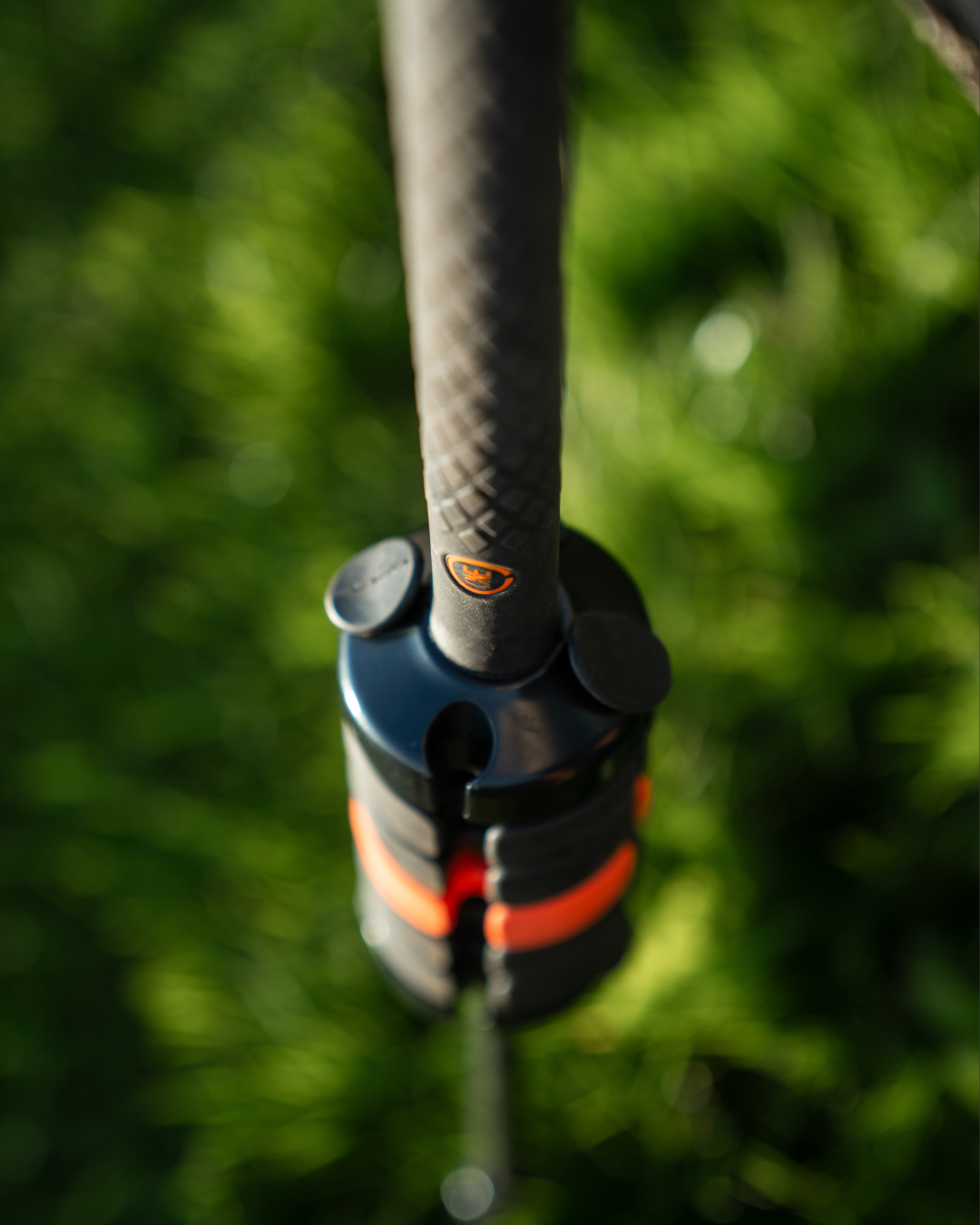
The cue I use with my own players is the simplest one out there: feel like your front foot fires into the ground first. The pressure shift to the lead side starts the chain. The torso follows because it has nowhere else to go. The arms and hands come through last, and at the moment of impact the club arrives at the ball with a square face that points at the target. If you feel like your arms or hands are starting the downswing, you have already lost speed and you have probably opened the clubface, so you cannot hit the ball cleanly. That is the root cause of poor ball striking for most amateurs I see. Resistance trainers, the kind that add load to the club and punish a top-down move, are useful here because they make a mistimed swing physically harder. They also build the kind of golf swing speed you can repeat, not the kind you have to muscle. The ONE Club Trainer is one of the tools I lean on for this, because the weighted cylinder gives you instant feedback the moment your sequence breaks down.
The finish, again, is the tell. A full finish with the chest facing the target, weight stacked on the lead leg, and trail toe pointed down means the sequence worked. Anything short of that means something earlier in the chain needs attention.
Build a practice routine that actually pays back
Practice that improves a swing looks very different from practice that just feels productive. The motor-learning research, summarized in Golf.com's coverage of random versus blocked practice, shows that mixing the two beats either one alone. Blocked practice (doing the same drill many times in a row) builds the pattern. Random practice (rotating between different shots and clubs) transfers that pattern to the course. The studies consistently find that random practice feels worse in the moment but produces better real-round results.
A simple thirty-minute range session that uses both: spend the first ten minutes on one specific drill, then fifteen minutes hitting the golf shots you would actually face on the next round, rotating clubs every shot. Include a couple of short chip shots and at least one drive, since the rhythm correction needed for each is different. End with five minutes of pressure shots where you visualize the actual hole on your home golf course, pick a target, and commit fully. That session beats two hours of mindless ball-beating, every time.
At home, short sessions matter more than long ones. Ten focused minutes three times a week with a training aid that gives instant feedback on tempo and release will move you further than an hour of waggling in front of a mirror. Resistance-based trainers in particular are useful between range visits because they keep the kinetic chain awake without needing a ball. A weighted swing tool like the ONE Club Trainer reinforces the feel of a correct release, so the body keeps the new pattern between sessions rather than reverting back to the old one.
How long does it actually take to see improvement
Most amateurs see measurable change in two to four weeks of consistent work, and a meaningful drop in handicap of one or two strokes in three to six months. That timeline assumes a few short sessions a week, not a complete overhaul of the swing in one day. The bigger the change you are trying to make, the longer the timeline, because the body has to unlearn the old pattern as much as it has to learn the new one.
The honest truth is that most amateurs who try to fix their swing in a weekend make it worse for a few weeks before it gets better. The new pattern feels slower at first, the contact feels worse, and the scores often go up before they come down. That is not a failure of the lesson or the drill, it is how motor learning actually works. Stick with the new pattern long enough for it to feel natural under no pressure, then long enough again to hold up under pressure, and the improvement will stay.
How to improve your golf swing questions
How long should I practice each week to actually get better?
Three to four sessions of twenty to thirty focused minutes each is plenty for most amateurs. More than that and the marginal return drops off fast because fatigue starts introducing new errors. Consistency beats volume.
Should I take lessons or work on my own?
Both. A handful of lessons with a coach who films your swing gives you the technical foundation. Solo practice with a training tool that provides instant feedback lets you ingrain the lesson between sessions. They work together, not as substitutes for each other.
Is it better to focus on power or accuracy first?
Accuracy. Strokes-gained data shows that hitting more fairways and greens drops scores faster than gaining extra yards, especially for handicaps above ten. Build the repeatable swing first, then chase distance once contact is consistent. The research behind that conclusion is documented in Mark Broadie's strokes-gained framework, which is now the standard the PGA Tour itself uses.
What is the single biggest mistake amateurs make?
Starting the downswing with the arms instead of the lower body. Almost every other fault, including the slice, the fat shot, and weak contact, can be traced back to this one error in sequencing. Fix the order and most of the other problems shrink on their own.
Is there really such a thing as a perfect golf swing?
Not in the textbook sense. Tour pros all have personal quirks, and good golf is measured by how repeatable the swing is, not how closely it matches a model. The most useful golf tips and golf swing tips for any handicap are the ones that simplify your motion rather than add layers to it. A swing you can repeat at 80 percent intensity, under pressure, will beat a "perfect" swing you only deliver one time in ten. If a small adjustment to how you swing a golf club feels easier, not harder, you are almost certainly heading in the right direction.